
The Hidden Cost of “Cheap” Simulator Hardware
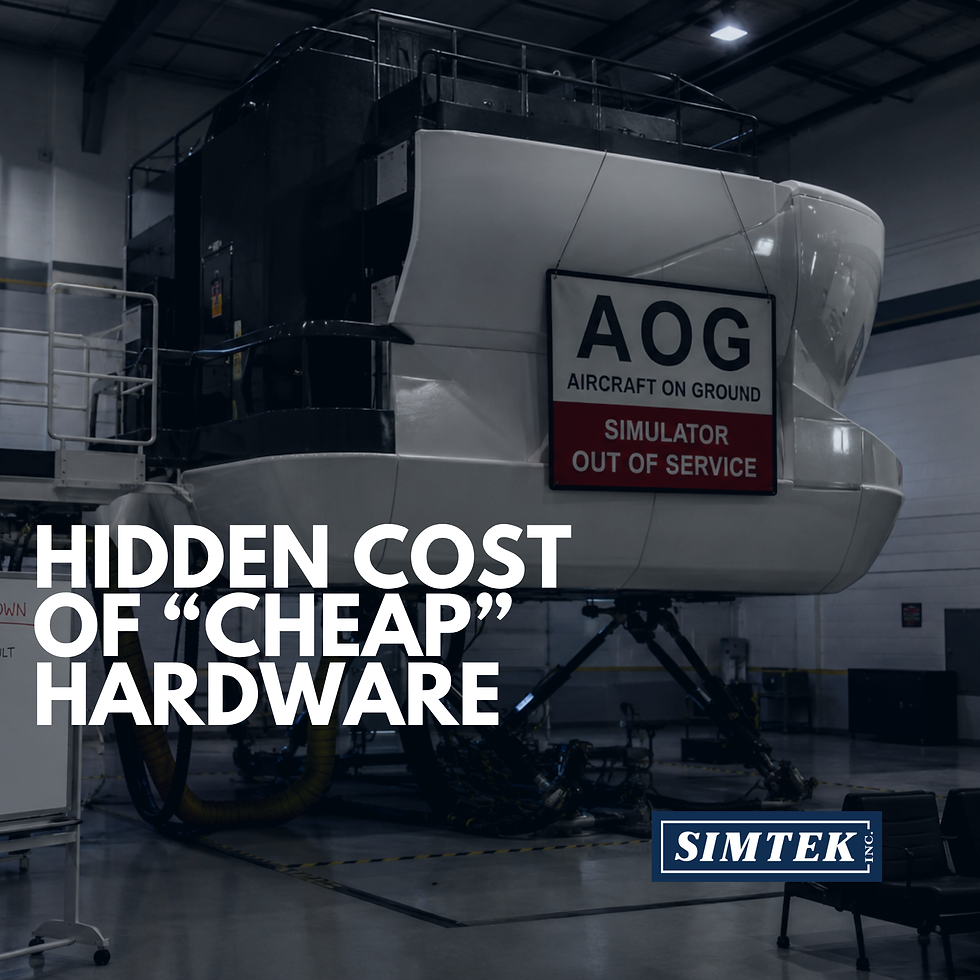
Lower-cost simulator hardware can be attractive at the beginning of a program.
Budgets are tight. Schedules are aggressive. A lower initial quote may appear to create an easy path to getting a device built, delivered, and into service. But the purchase price is only one part of the cost.
For simulator OEMs, training organizations, and program managers, the more important question is not simply, “What does this hardware cost today?” It is:
What will it cost to keep this simulator reliable, usable, supportable, and available over its life?
Cheap hardware does not always mean low-fidelity hardware. A lower-fidelity trainer can be a smart and effective solution when it is intentionally designed around the required training objectives.
The issue is hardware that is inexpensive because reliability, consistency, maintainability, quality, supportability, or engineering discipline were sacrificed to reach a price point.
That is where the real cost begins.
The Purchase Price Is Only the Starting Point
A simulator is expected to train day after day, often across multiple shifts, instructors, students, maintainers, and training scenarios.
When a control panel, display, instrument , or interface component is selected primarily because it has the lowest upfront price, the initial savings can quickly disappear through:
Frequent component failures
Unplanned maintenance
Inconsistent control feel between stations
Poor lighting performance
Rework after installation
Limited or unavailable spare parts
Longer troubleshooting cycles
Simulator downtime
Lost training availability
The cost of one failed component is rarely limited to the replacement part. It can include labor, shipping, diagnosis, removal, installation, retesting, documentation, scheduling disruptions, and missed training events.
A simulator that cannot train is not a low-cost solution.
Failures Create More Than Maintenance Work
Hardware failures are disruptive even when the failed item appears minor.
A failed annunciator, unreliable switch, dim display, intermittent encoder, or worn control may prevent a simulator from being used as intended. Even when training can continue, degraded hardware can create instructor frustration, reduce student confidence, and make the device feel less representative of the aircraft environment.
Repeated failures also place a burden on maintenance personnel. Instead of focusing on planned maintenance, improvements, and readiness, technicians are forced into reactive troubleshooting.
Over time, this can turn a simulator into a constant maintenance project.
Reliable hardware is not about eliminating every possible failure. It is about designing and selecting components that can withstand the operating environment, support repeated use, and be maintained without creating unnecessary simulator downtime.
Inconsistent Feel Undermines Training Value
Controls should feel consistent.
A switch that is too loose, a pushbutton with an unrealistic travel, an encoder with uneven detents, or a control that behaves differently from one station to another can reduce the credibility of the training environment.
Instructors notice it. Students notice it. Maintenance teams notice it when the same controls repeatedly require adjustment or replacement.
The goal is not always to duplicate every aircraft component at full OEM fidelity. But the hardware should be intentionally designed to provide a repeatable, appropriate, and durable user experience for the intended training level.
When low-cost components are substituted without considering tactile feel, service life, mounting method, or repeatability, the result is often a simulator that looks acceptable from a distance but feels inconsistent during use.
That inconsistency can become especially noticeable in high-use areas such as glare shields, center pedestals, overhead panels, displays, flight controls, and instructor-operated stations.
Component Selection Problems Are Often Discovered Too Late
Component selection has a direct effect on simulator reliability and lifecycle cost.
Low-cost switches, pushbuttons, encoders, indicators, and other cockpit controls may look acceptable during initial assembly, but they are not always designed for the repeated use expected in an active training device. Low cycle-life ratings, inconsistent tactile response, weak mounting features, and limited supplier support can create failures long before the simulator reaches the end of its expected service life.
A switch or pushbutton failure may seem minor, but it can interrupt training, require troubleshooting, consume maintenance resources, and reduce simulator availability. When the original component is no longer available, the repair may also require redesign, rework, and additional validation.
Selecting components based on expected use, cycle life, tactile feel, maintainability, and long-term availability helps prevent avoidable downtime after the simulator is in service.
Rework Can Erase Initial Savings
The lowest-cost option is often based on assumptions that do not survive integration.
A component may fit physically but not interface correctly. A display may not provide the required brightness or resolution. A panel may lack proper access for maintenance. A control may not hold up under repeated use. An interface may require additional electronics, software changes, or wiring modifications that were not included in the original price.
These issues create rework.
Rework is expensive because it typically occurs after decisions have already been made, drawings have been released, material has been purchased, and labor has been invested. It also tends to happen under schedule pressure, which can lead to expedited freight, rushed engineering changes, and additional testing.
The result is a project that looked less expensive on paper but costs more by the time the simulator is delivered and operational.
Unavailable Spares Turn Small Problems Into Long Downtime
Supportability matters.
Many low-cost components are selected because they are readily available at the time of purchase. But simulator programs often remain in service for years or decades. A supplier may discontinue a display, change a connector, update an internal design, stop supporting a product line, or simply exit the market.
When replacement hardware is no longer available, a simple repair can become a redesign effort.
That may require:
Reverse engineering
Mechanical redesign
New electronics
Updated interfaces
Software changes
New drawings and documentation
Qualification or regression testing
New spare inventories
A well-designed simulator hardware strategy considers not only what can be purchased today, but also what can be maintained tomorrow.
This does not mean every component must be custom. It means the design should consider lifecycle availability, replacement paths, modularity, repairability, and long-term support from the beginning.
Simulator Availability Has Real Value
The most important cost is often lost simulator availability.
When a device is down, training schedules are disrupted. Instructors must adjust. Students may lose scheduled training time. Maintenance resources are diverted. Customer confidence can be affected. In some cases, the organization may need to use another device, extend shifts, or reschedule training altogether.
The initial savings from a lower-cost hardware decision can be quickly outweighed by even a small amount of lost availability.
Simulator hardware should support the overall mission of the device: reliable, repeatable training.
That means considering the full lifecycle cost of the hardware, not just the initial purchase price.
The Right Cost Is Not Always the Lowest Cost
A smart hardware decision balances cost, fidelity, reliability, maintainability, and training value.
There is a place for lower-fidelity solutions. There is also a place for cost-effective design. The key is ensuring that cost reduction is intentional and engineered—not achieved by accepting unreliable components, poor lighting, unsupported parts, inconsistent controls, or difficult maintenance.
The best simulator hardware is not necessarily the most expensive option. It is the option that delivers the required training value while remaining reliable, supportable, maintainable, and available throughout the life of the simulator.
At Simtek, we believe simulator hardware should be designed for more than delivery day. It should be built for the years of training that follow.


